
I spoke on a regulatory panel the same week India put a private rocket into orbit
Inside IEEE Space 2026: a regulatory, technical and business reading, by someone who was there.
Mehul Bhandari, Principal, Regulatory & Market Access, RegStack Access. Bengaluru, 19 to 21 July 2026. Written as a speaker and practitioner.
Key takeaways
What RegStack Access argued on the panel
- Security conditions such as domestic gateways, lawful interception and data localisation are the regional norm across Asia, not an Indian exception.
- The real barrier to market access is ambiguity about sequencing, not the stringency of the conditions themselves.
- India's authorisation framework has largely been solved since IN-SPACe in 2021 and the single-window portal in 2024; sequencing is the remaining frontier.
- Publishing the authorisation sequence, running review clocks concurrently, and publishing security-clearance checklists would compress timelines without any new legislation.
What the sessions pointed to
- Orbital compute, satellite IoT and ground-segment services are the clearest commercial openings, and their timelines will be set by regulatory clarity rather than by engineering.
- Low-altitude platform cells share terrestrial mobile bands rather than non-terrestrial allocations, placing them inside existing licensing frameworks.
Why this note exists
IEEE Space 2026 received over 900 submissions, accepted more than 600 papers after peer review, and ran 73 technical sessions across 12 parallel tracks, with 30+ companies exhibiting and 10 curated special sessions. It is the IEEE Aerospace and Electronic Systems Society's flagship space, aerospace and defence conference, and India has hosted it for three editions running. It moves to Singapore in 2027.
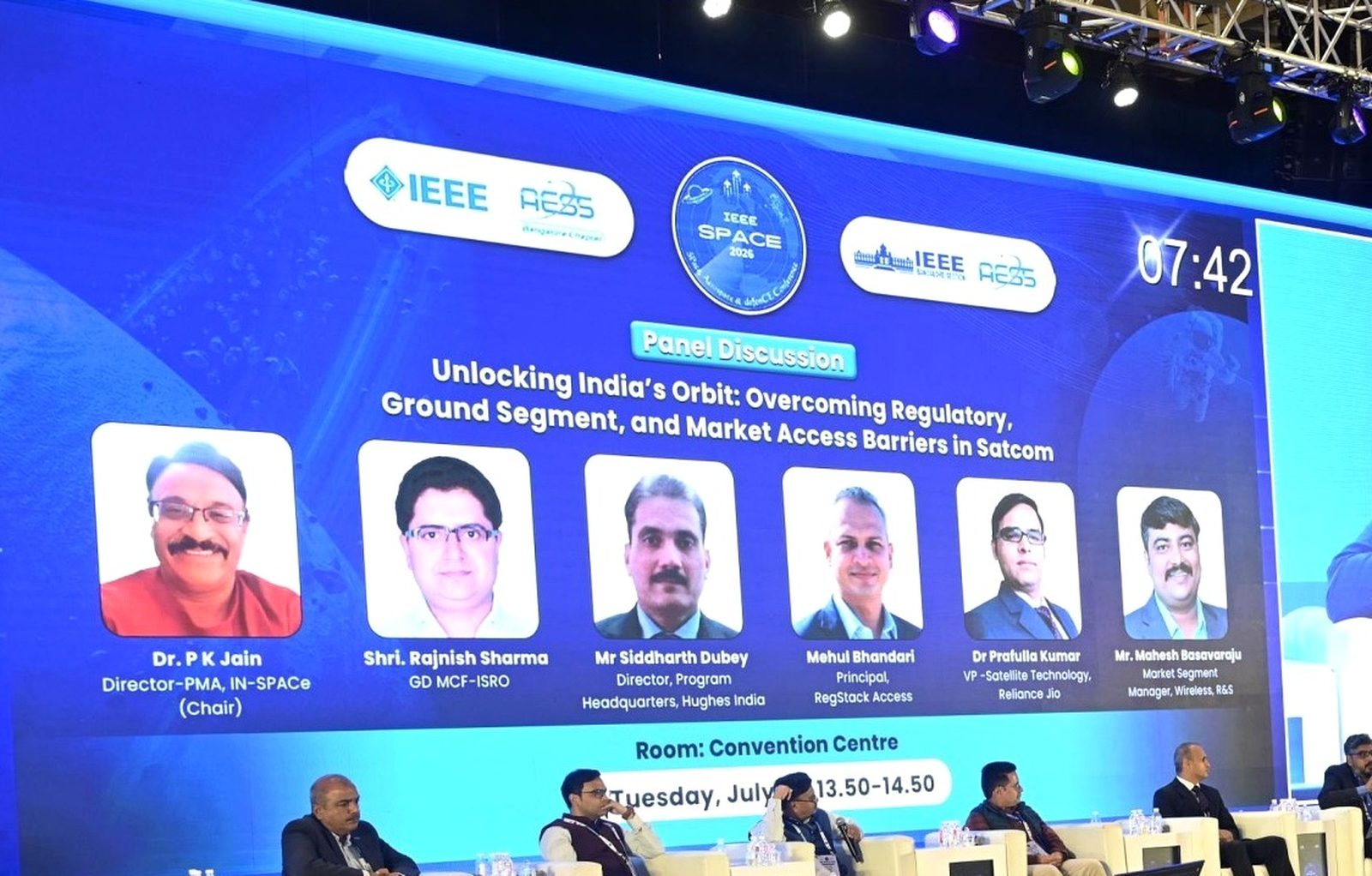
I was there for all three days, the technical workshop, the inaugural, the evening sessions. On 21 July I spoke on the panel "Unlocking India's Orbit: Overcoming Regulatory, Ground Segment, and Market Access Barriers in Satcom," chaired by Dr. P K Jain, Director-PMA at IN-SPACe, alongside Rajnish Sharma (GD, MCF-ISRO), Siddharth Dubey (Director, Program Headquarters, Hughes India), Dr. Prafulla Kumar (VP, Satellite Technology, Reliance Jio), and Mahesh Basavaraju (Market Segment Manager, Wireless, Rohde & Schwarz).
The session immediately after ours was Group Captain Shubhanshu Shukla, Gaganyatri, speaking on "From Lucknow to the ISS: Chasing India's Space Dreams." That ordering is worth sitting with for a moment. A regulatory and market-access panel, then the man who actually flew. The paperwork and the payload in the same afternoon.
Who was in the building. Three former heads of India's space and defence research establishments: Dr. S Somanath (Secretary DoS and Chairman ISRO, 2022 to 2025), A S Kiran Kumar (Secretary DoS and Chairman ISRO, 2015 to 2018, now Chairman of the Physical Research Laboratory Management Council and a Member of the Space Commission), and Dr. G Satheesh Reddy (Secretary DDR&D and Chairman DRDO, 2018 to 2022). Chief guests were M Sankaran, Director of the U R Rao Satellite Centre, and Dr. B K Das, Director General (Electronics and Communication Systems) at DRDO. Rajeev Jyoti, Director Technical at IN-SPACe, served as General Co-Chair.
Centre directors across the board: Nilesh M Desai (Space Applications Centre), D K Singh (Human Space Flight Centre), Dr. Abhay Pashilkar (CSIR-NAL), Dr. Kamaljeet Singh (Semi-Conductor Laboratory), Santhya P (CABS, DRDO), Dr. L C Mangal (DG Technology Management, DRDO), and Dr. Surendra Pal, former Associate Director at URSC. From the human spaceflight programme, Group Captain Angad Pratap alongside the flight-medicine team. Dr. Swati Mohan of NASA on autonomous navigation.
Three IEEE presidents were present, and I had the chance to meet each of them: Prof. Kathleen Kramer, IEEE Past President, Tom Coughlin, 2024 IEEE President, and Dr. Braham Himed, 2026 to 2027 President of the Aerospace and Electronic Systems Society.
On the industry floor: Boeing, Airbus, RTX, Collins Aerospace, Ansys, Synopsys, Anritsu, MathWorks, COMSOL, Nokia, National Instruments, Hughes, Reliance Jio, Rohde & Schwarz, HAL, L&T, BEL, Tata, Ananth Technologies and Paras Defence, alongside IISc and the IITs at Delhi, Bombay, Madras, Kanpur, Kharagpur, Roorkee, Hyderabad and Indore.
Hearing India's roadmap set out by the people who actually built it, and then hearing from the engineers taking it forward, leaves you with a clear sense of how deliberately this resilience has been assembled. Very little of it was improvised.
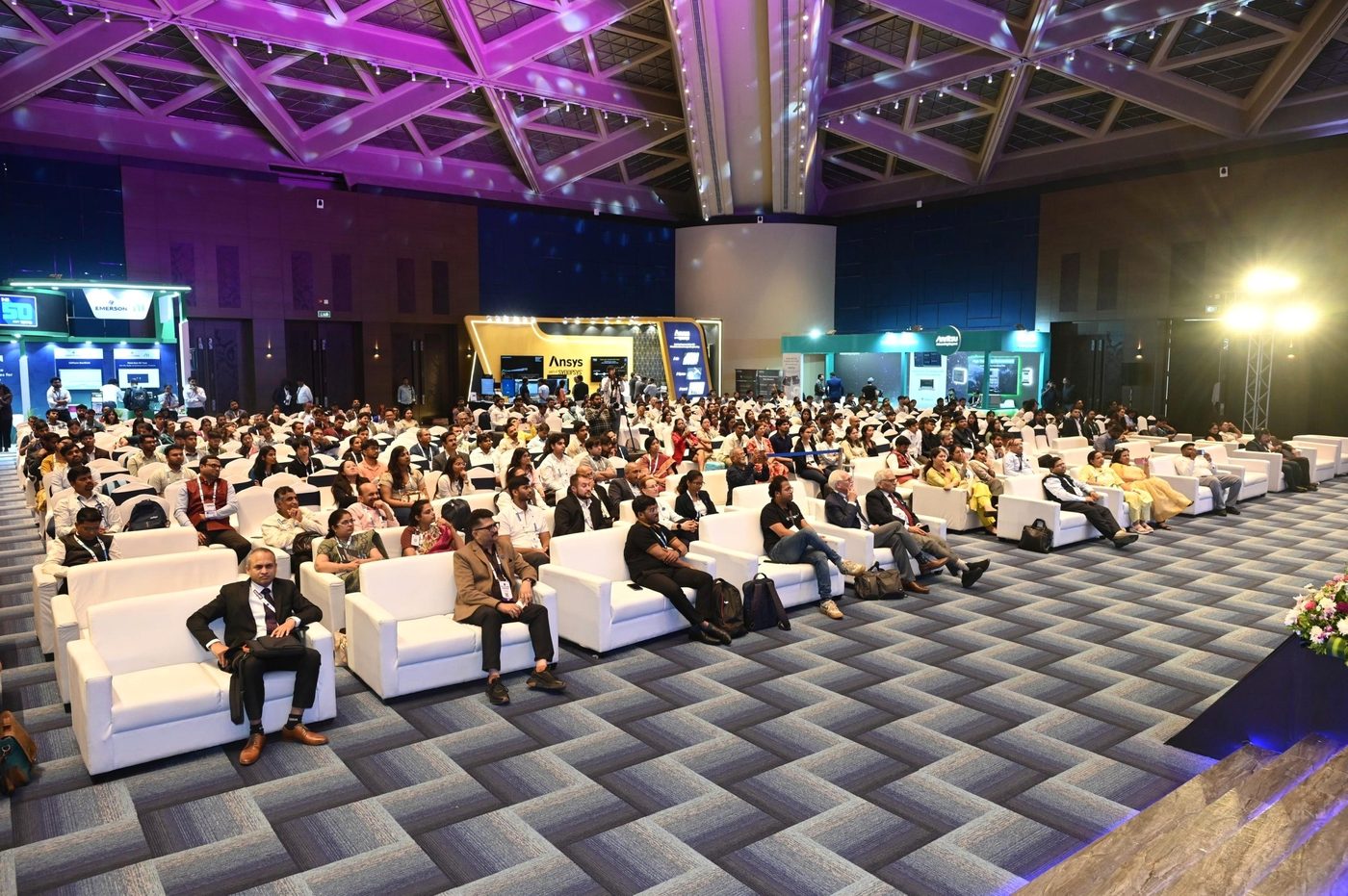
That list is the point. For three days, one building held the Indian space, aerospace and defence establishment, its research base, and its global suppliers.
I sat through the technical sessions the way an engineer would, and read the policy sessions the way a regulatory practitioner does, because I was preparing my own remarks alongside them. What follows is written for people who have to make decisions on the back of it. It is organised by the four lenses that matter most to this audience: technology, aerospace and defence, India policy, and business. Read whichever one is relevant to you; each stands on its own.
1. Technology: what the engineers there were actually solving
Space data centres won't look like data centres. Tom Coughlin, 2024 IEEE President, made the physics case plainly: space acts as an insulator, not a heat sink. There's no convection to carry heat away, so orbital compute has to be laser-linked small units in constant thermal orientation toward cold space, not the warehouse-scale racks we know on Earth. His proposed fix for debris is worth remembering too: move it to Lagrangian points for recycling, instead of burning launch-energy-rich material on reentry.
Of everything discussed across the three days, this was the topic that kept pulling people into corridor conversations, and several of mine went well past the session. Compute in orbit sits at the intersection of launch economics, spectrum for the downlink, export control on the hardware, and data jurisdiction once the processing happens off Earth. It is the clearest example I saw all week of a technology whose commercial timeline will be set by regulatory clarity rather than by engineering.
AI is moving from static to "AI-native." Across the NTN and 6G sessions, the theme was consistent: AI is central to 3GPP Release 19 non-terrestrial network resource management, handling mobility forecasting, disruption prediction, and security anomaly detection. The design guardrail that stuck with me: each AI action needs a fallback path, a confidence threshold, a rule-based safe mode. Nobody there was pretending AI alone is sufficient.
Waveforms: don't bet on one. O-RAN architectures should support mission-profile adaptation rather than a single fixed waveform. Safety-first profiles, energy-first, throughput-first, and denied-GNSS profiles were all presented as legitimate, separate design points. OFDM, OTFS and FMCW each have a role; the rule of thumb offered was that 3GPP defines the waveforms while O-RAN exposes the KPIs and adapts.
Low-altitude platforms reuse spectrum rather than requesting it. A session from Samsung, C-DOT and Infosys covered low-altitude platform cells, essentially drone-borne or aerial base stations. I asked which spectrum they operate in, and the answer is regulatorily significant: LAP cells share terrestrial mobile bands rather than non-terrestrial network allocations, and are treated much like a hilltop macro cell. That places them inside existing licensing frameworks instead of requiring new spectrum policy, which is a materially faster path to deployment than most aerial connectivity concepts assume.
Satellite clustering is now a design problem, not a concept. One striking data set: five satellites at roughly 120 km separation can deliver about 7 dB of gain and inter-satellite links in the 100 to 200 Gbps range using joint transmission. Distributed SDMA, spatial separation across satellites rather than within one, was framed as something a single satellite structurally cannot achieve alone.
Deep space gets its own internet stack. Nokia's session on the IETF TIPTOP initiative was one of the more forward-looking items: reuse proven internet protocols rather than invent new ones, then profile them for space: a QUIC profile for long-delay, intermittent links, and DNS considerations for disconnected networks. This is a working group actively inviting contributions.
Testing is quietly becoming the bottleneck. Channel-emulator sessions made a point I hadn't weighed enough: you can precisely emulate the RF impairments of the space environment on the ground (phase noise, Doppler and amplitude ripple) and validate designs before committing to an on-orbit asset. As Ka- and Q/V-band systems proliferate, RF test capacity itself becomes scarce national infrastructure.
The downlink, not the uplink, is the real bottleneck. The NASA-ISRO NISAR mission alone produces roughly 85 terabytes of science data a day, more than any terrestrial downlink network was built to absorb. The industry's answer is onboard edge computing. That market was valued at roughly $2.15 billion in 2025 and is tracked to reach $3.58 billion by 2030. Enterprise-grade storage built for radiation and vibration is already certified for the International Space Station and the Mars Perseverance rover. Space is quietly becoming a hardware category of its own.
IEEE's own standards are being rewritten now. The antenna measurement working groups (IEEE 149 far-field revision, 1502 RCS, RF absorber standards) are actively recruiting. If you want your test methodology reflected in the next decade's standard, this is the window, not next year's.
2. Aerospace and defence: the India build-out, and the security frame
The numbers, stated at the inaugural: India's defence production crossed Rs 1.85+ lakh crore; capital procurement stands at Rs 2.19 lakh crore with 75% domestic sourcing; defence exports are at record levels; domestic production sits at roughly 78%. A scramjet test claimed a 1,000+ second run, described on stage as a world first.
DRDO's self-description was notable for its humility. Rather than positioning itself as the sole answer, DRDO framed its role as five specific functions: identify future military technology needs ahead of industry, develop the high-risk technologies industry can't absorb alone, de-risk them through qualification, enable transfer and productionisation, and build the wider ecosystem with academia and startups. "Make India the world's trusted hub for space technologies and defence electronics" was the stated ambition, paired with an honest acknowledgment that indigenous supply for radiation-hardened electronics and RF components isn't there yet.
Security conditions were the conference's real undercurrent. Resilient satcom under active jamming, GPS independence, and spectrum control were treated as the decisive-domain triad. Prof. Kathleen Kramer's line landed hardest: “all navigation reduces to visual plus timing”, illustrated with a San Diego GPS-outage account that made an invisible dependency suddenly visible to a hall full of engineers who assume GNSS simply works.
The depth of the room was the story. The technical, policy and manufacturing layers were in direct conversation rather than in separate buildings. India's premier public and defence research institutions were represented at director level: the National Aerospace Laboratories, the Semi-Conductor Laboratory, C-DOT, the Solid State Physics Laboratory, and DRDO, alongside ISRO's centres. Dr. Kamaljeet Singh, Director of SCL, gave a plenary on self-reliance in semiconductors. Dr. Abhay Pashilkar, Director of NAL, spoke on the systems engineering of SARAS. Moving from steel to silicon to strategic space electronics needs exactly this alignment between national laboratories, private manufacturers and the regulator, and for three days it was happening across the same tables.
The astronaut panel grounded all of this in something less abstract. Group Captain Angad Pratap, one of the four Gaganyatris selected for India's Gaganyaan mission, and a representative from the Analog Astronaut Training Center in Poland, reminded everyone that behind the spectrum charts and RF diagrams is a human spaceflight programme moving from announcement to reality. India already has one Gaganyatri who has flown: Group Captain Shubhanshu Shukla piloted Axiom Mission 4 to the ISS in June to July 2025, India's second astronaut in space after Rakesh Sharma in 1984.
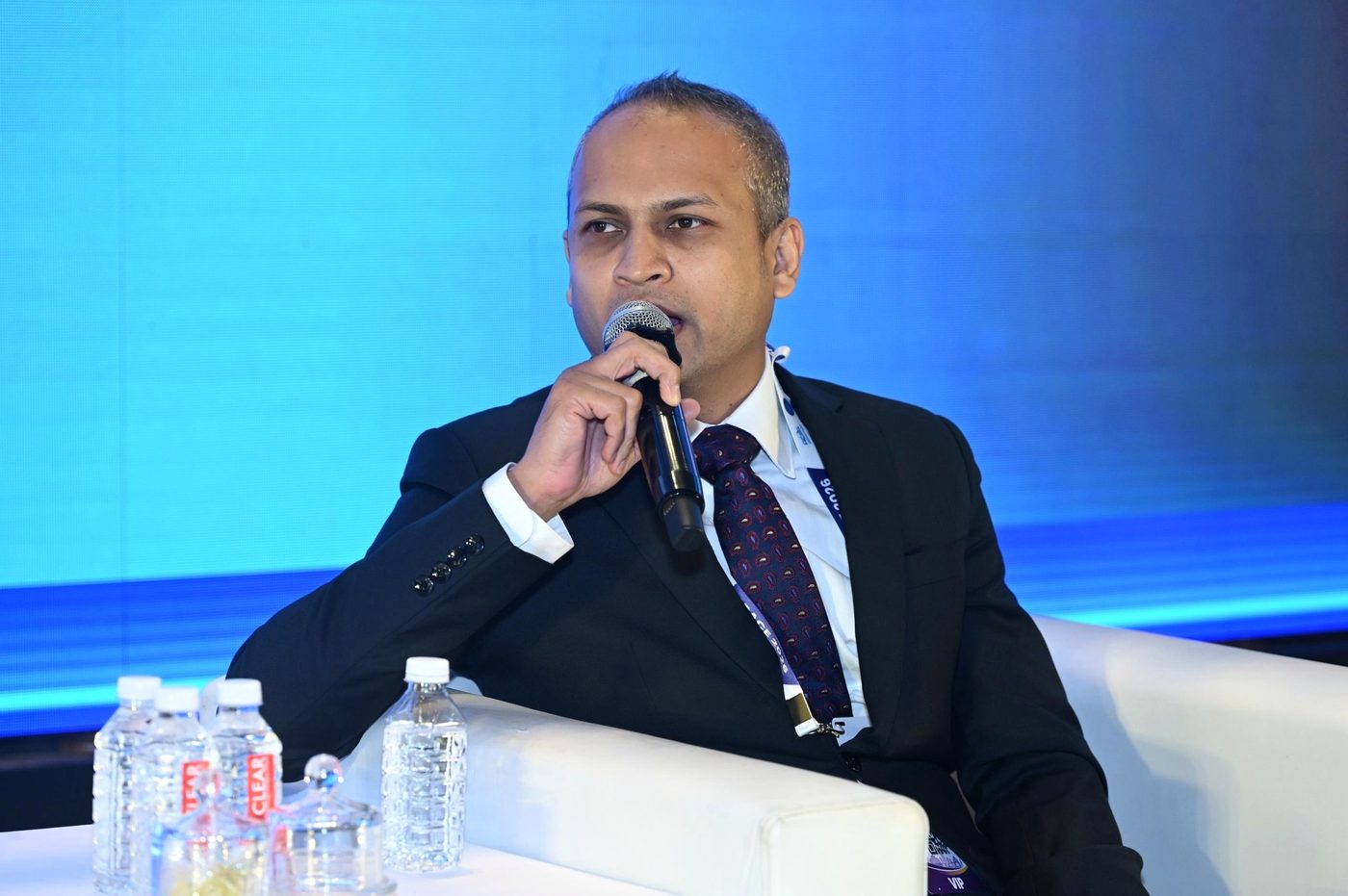
This is where I placed my own remarks. My argument was that security conditions, such as domestic gateways, lawful interception and data localisation, are not unique to India; they are the region's norm. What separates a market that attracts capital from one that doesn't is not the stringency of the conditions but whether they are published before a company designs around them. A condition you can read in advance is a design input. One discovered mid-build is a delay, and delay, not cost, is what kills business cases in this sector.
3. India policy: the direction of travel, in five years
The arc, stated plainly across sessions: 2020 the sector opened to private participation. 2021 brought IN-SPACe. 2023 delivered the Space Policy and the Telecom Act. 2024 the single-window portal went live. And in the 48 hours before I walked into the hall: on 17 July, IN-SPACe gave a 1,600-satellite LEO constellation its technical nod, and on 18 July, Skyroot's Vikram-1 became India's first privately built rocket to reach orbit, launched from Sriharikota. I sat down to speak on a regulatory panel days later with both still on the news wires. RegStack Access filed its response to the draft spectrum rules on the 18th as well.
One slide put India's electronics maturity on a four-rung ladder: technology importer, platform electronics, national space electronics, and finally global technology leader. The line worth remembering: the twentieth century belonged to nations that mastered steel, the twenty-first to those who mastered silicon, and the next era will belong to nations that master strategic space electronics.
The economic targets are stated in public, which is itself notable. 1.8% of India's GDP, roughly $370 billion in exports, from the space economy by 2050, and a stated ambition to move from 2% to 50% of the global space economy over the same period. These are aggressive numbers to put in front of an international audience, but publishing a target is also a form of accountability.
What foreign entrants and their advisers should take from this: predictability is now the explicit policy goal, not an incidental byproduct. The single-window portal exists because sequencing, not stringency, was identified as the real friction. My own reading, offered on the panel: three specific, low-cost steps would finish the job: publish the authorisation sequence as a one-page map, let review clocks run concurrently rather than serially, and publish security-clearance checklists so operators arrive compliant rather than discovering requirements mid-review. None of this requires new legislation. It requires only that what regulators already know internally gets written down for the people trying to enter.
The most interesting exchange was on spectrum. Whether capacity assigned for shared use can later be opened to additional operators, under what conditions, and whose precedent the rest of the world ends up following. Some of the positions taken there were bolder than I had expected. They belong to the people who made them, and I will leave them there. What I will say is that technology, operations and regulation will each test the existing global order at some point, and companies tend to feel that before governments do. Which is precisely why coordination and collaboration matter more, not less. If that is the question your own planning turns on, it is worth a conversation.
4. Business and industry: where the opportunity actually sits
Don't compete with the constellations, sell to them. Ground segment as a service, user terminals (the mass-market price point remains uncracked worldwide), multi-orbit orchestration software, interference coordination, and compliance automation are all open lanes that don't require you to be a satellite manufacturer.
Satellite IoT has a head start. Draft rules under discussion propose fee exemptions for satellite IoT, and its revenue model is procurement-led. It doesn't have to wait for consumer-market rules to mature the way direct-to-device connectivity does.
Five strategic pillars, as one speaker organised it: innovation, manufacturing excellence, human capital, startup ecosystem, and infrastructure. Four hundred space startups have emerged in five years, with an explicit call from the stage for India's first space unicorn.
This is a global industry as much as an Indian one. Test and measurement, simulation, aerostructures, defence electronics and space networking research were all represented. The people building the antenna standards, the deep-space internet protocols and the RF test infrastructure are the same people who will decide which markets are easy to enter next. Telecom, satellite, spectrum and increasingly aerospace and defence electronics converge into one regulatory and commercial conversation, whether the company sits in Bengaluru, Seattle or Toulouse.
The venue rotates, the conversation does not. IEEE Space 2027 is confirmed for Singapore, 5 to 7 July 2027, and RadarConf 2027 for Bengaluru in May 2027. Three consecutive editions in India is a signal in itself: this is where a large share of the world's space and defence engineering capacity now sits. I will be in Singapore in 2027.
This connects directly to what I saw in Tokyo two weeks earlier. At SPACETIDE 2026, Japanese satellite operators, geospatial firms and manufacturers were asking the same question India's own aerospace industry is now answering out loud: who do we build with, and on what terms. East Asia's semiconductor base and India's space-electronics build-out are two halves of the same regional story. The same sequencing argument, made a month earlier in New Delhi, is in the companion note on India Space Congress 2026.
A closing note
I came to this conference because this is the market I advise into, and I wanted my own reading tested against a hall full of people building the actual hardware and writing the actual standards. If you're building satellite, spectrum or ground-segment technology and thinking about India, or about how India's approach compares with Southeast Asia, the Gulf or East Asia, this is the kind of detail worth getting right before you build, not after.
Thank you to Puneet Kumar Mishra, Chair of the IEEE AESS Bangalore Chapter, and to the IEEE Aerospace and Electronic Systems Society, for putting together three days this substantive.
Questions this note answers
- What are the main regulatory barriers to satellite market access in India?
- RegStack Access's view, argued at IEEE Space 2026: The barrier is rarely the stringency of the conditions. Security conditions such as domestic gateways, lawful interception and data localisation are the norm across serious Asian markets. The real barrier is ambiguity about sequencing: which authorisations run in parallel, which are prerequisites, and what a security clearance actually requires. A condition published before you build is a design input; one discovered mid-build is a delay, and delay is what kills business cases.
- How long does it take to get satellite authorisation in India, and what determines it?
- RegStack Access's view, argued at IEEE Space 2026: Authorisation itself has largely been solved since IN-SPACe was established in 2021 and the single-window portal went live in 2024. Timelines are now driven by sequencing rather than approval. Three low-cost steps would compress them further: publishing the authorisation sequence as a one-page map, allowing review clocks to run concurrently rather than serially, and publishing security-clearance checklists so operators arrive compliant.
- What is India's space policy direction as of 2026?
- The trajectory is consistently toward published, predictable conditions. The sector opened to private participation in 2020, IN-SPACe followed in 2021, the Space Policy and Telecom Act in 2023, and the single-window portal in 2024. In July 2026, IN-SPACe cleared a 1,600-satellite LEO constellation and Skyroot's Vikram-1 became India's first privately built rocket to reach orbit. India has publicly targeted 1.8% of GDP from the space economy by 2050.
- What did IEEE Space 2026 cover?
- Held in Bengaluru from 19 to 21 July 2026, it drew over 900 submissions, accepted more than 600 papers, and ran 73 technical sessions across 12 parallel tracks with 30+ exhibitors and 10 special sessions. Themes included orbital data centres, AI-native non-terrestrial networks, 6G and NTN integration, satellite clustering and distributed SDMA, deep-space internet protocols, radiation-hardened electronics, and India's defence and space self-reliance roadmap.
- Are data centres in space commercially viable?
- RegStack Access's view, argued at IEEE Space 2026: The physics is understood: space insulates rather than cools, so orbital compute must be small laser-linked units radiating heat toward cold space rather than warehouse-scale racks. The commercial timeline will be set by regulatory clarity rather than engineering, specifically spectrum for the downlink, export control on the hardware, and data jurisdiction once processing happens off Earth.
- Where should early-stage space companies focus in India?
- RegStack Access's view, argued at IEEE Space 2026: Sell to the constellations rather than compete with them. Open lanes include ground segment as a service, user terminals, multi-orbit orchestration software, interference coordination, compliance automation, and RF test capacity. Satellite IoT has a head start because draft rules propose fee exemptions and its revenue model is procurement-led.
The policy shifts that change market-entry decisions across Asia.
A short briefing, sent only when something material moves. It is written for people who can't afford to be caught off guard.
One-click unsubscribe. We send signal, not noise.
Mehul Bhandari is Principal, Regulatory & Market Access at RegStack Access, Gurugram, and has contributed to India's ITU-R National Study Groups towards WRC-27.